
Blog · Existing Conditions
How Aerial Roof Condition Reports Work for Commercial Properties
A practical guide for property managers, GCs, and owners who need a defensible record of a commercial building's roof condition without putting a person on the roof.
Last updated: June 10, 2026
In This Guide
- What an Aerial Roof Condition Report Actually Is (jump to section)
- What Kinds of Findings the Report Catches (jump to section)
- When a Property Manager Should Commission One (jump to section)
- How an Aerial Report Differs From a Traditional Roof Inspection (jump to section)
- What the Deliverable Looks Like in Practice (jump to section)
- Cost Comparison Table (jump to section)
- What to Look For When Choosing a Provider (jump to section)
- See a Real Roof Condition Report (jump to section)
- Frequently Asked Questions (jump to section)
If you manage a commercial property with a flat or low-slope metal roof, you already know the roof is the part of the building that takes the most punishment and gets the least attention. Most property managers only learn about a roof problem when a leak shows up on a ceiling tile or a tenant complains. By then the repair is more expensive than it would have been six months earlier.
An aerial existing-conditions roof report is a one-time, dated, geo-tagged record of the entire roof surface, delivered in a format that a roofer, an insurance carrier, or a property manager can act on. This guide covers what the report is, what is in it, when it is worth commissioning, and how it differs from a traditional roof inspection. If you are evaluating roof documentation options, the existing conditions documentation service page has the full pricing structure and what is included in the deliverable.
What an Aerial Roof Condition Report Actually Is
The deliverable is a single PDF that combines three things: a complete aerial photo set of the roof surface at consistent resolution, an annotation layer that flags each finding with a severity rating, a problem description, and a location tag, and a written narrative covering the major condition categories found on the roof.
The capture is done with a commercial aerial platform flying above the property. No one goes on the roof. The entire roof surface is captured in a single session, typically in under an hour on site. The annotation and report assembly is done in software (we use ImageInspector) and the report is delivered within 48 hours of the site visit.
The output is structured so a roofer, insurance carrier, or property manager can act on it without reformatting. Each finding is severity-rated (1-5), each is location-tagged, and the photos are organized into a single stakeholder-ready PDF.
What Kinds of Findings the Report Catches
A roof condition report typically flags five categories of condition across the roof surface. On a typical 8,000-10,000 sq ft commercial flat metal roof in Central Florida, the report will identify items like:
- Signs of prior repairs that should be inspected further to confirm current condition.
- Pooled water and organic debris in low areas of the roof, which can shorten the service life of the roofing material if not addressed.
- Roof vent rust and gasket wear at penetration boots, which are the most common sources of slow leaks on metal roofs.
- Weather wear on flashing, edges, and seams from long-term Florida UV and storm exposure.
- General oxidation and streaking patterns that indicate the roof is approaching the end of its expected service life.
Each category is severity-rated and prioritized. The property manager can hand the report to a roofer and have a productive conversation about which items to address first, with the annotated imagery as the discussion reference.
When a Property Manager Should Commission One
An aerial existing-conditions roof report is the right move in three situations.
Before a warranty expires. Most commercial metal roof warranties run 10-20 years. The year before the warranty expires is the right time to commission a dated record of the roof condition. If a future warranty claim comes up, the report becomes a defensible reference.
Before selling or refinancing the property. A lender or buyer will want to know the condition of the roof. A dated, severity-rated report is stronger than a roofer's verbal estimate because it is a documented record, not an opinion.
After a major weather event. A named storm, a hail event, or sustained heavy rain that produced leaks is the right trigger for a post-event inspection. The dated report becomes the record of the roof condition immediately after the event, which is what an insurance carrier will ask for.
How an Aerial Report Differs From a Traditional Roof Inspection
A traditional roof inspection puts a person on the roof with a clipboard. The inspector walks the roof, takes photos by hand, and writes up findings in a Word document or PDF. The output is a subjective assessment that depends on the inspector's experience and what they happened to walk past.
An aerial report captures the entire roof surface in a single pass at consistent resolution. The aerial perspective catches conditions a walker can miss: ponding water in low spots, fastener patterns across the full field of the roof, oxidation streaks that span large areas. The annotations are organized into a single PDF that a roofer or insurance carrier can act on without reformatting.
The trade-off is resolution. An aerial report is excellent for finding patterns, identifying problem areas, and producing a consistent record. It is not a substitute for a hands-on inspection by a roofer who needs to test fastener pull-out strength or probe a soft spot. The two are complementary: the aerial report is the catalog, the hands-on inspection is the diagnosis.
What the Deliverable Looks Like in Practice
Below is a screenshot from an actual annotated report we delivered for an 8,373 sq ft commercial flat metal roof in Sanford, FL. The green bounding box marks a specific area of concern, the dialog captures the severity rating, the problem description, and the location tag. The same annotation system is used across every finding in the report.
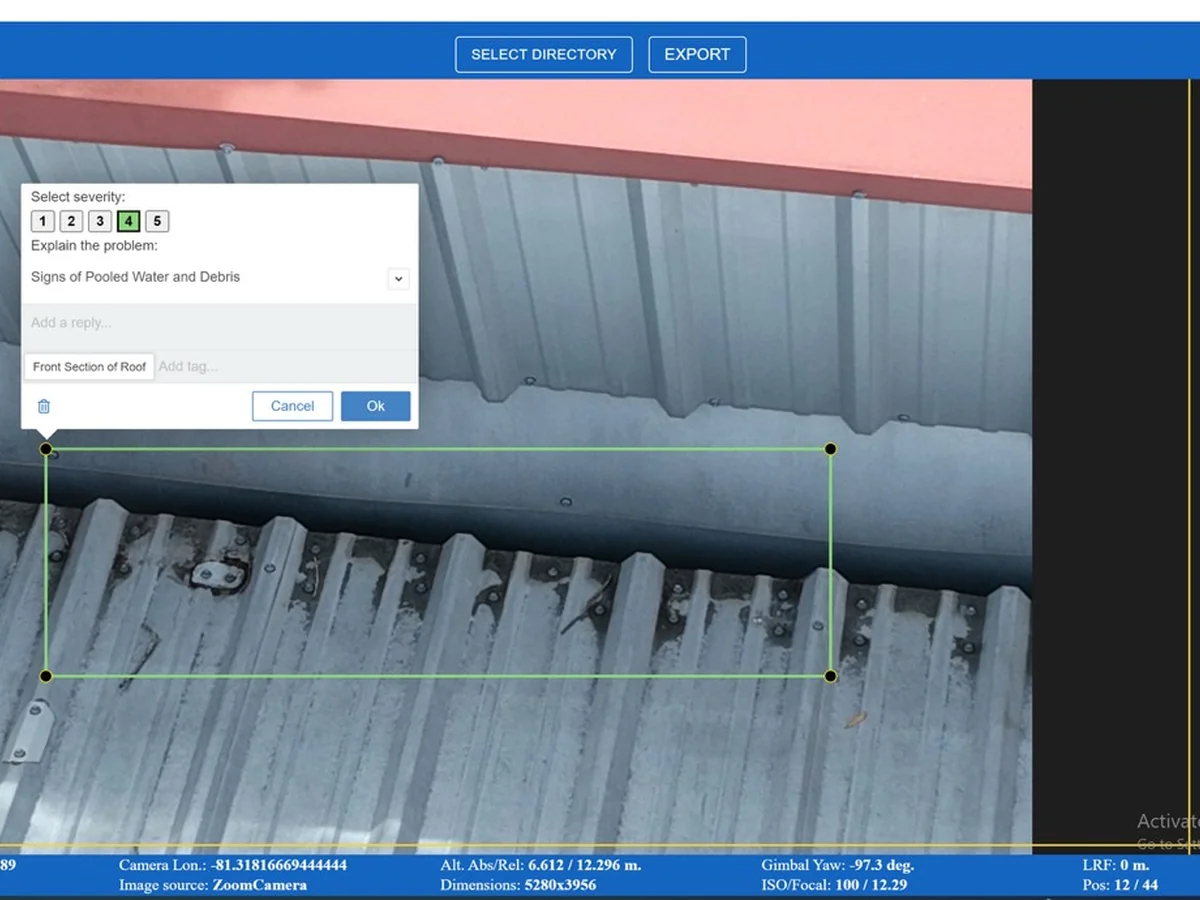
Sample finding from a real CrossFit eXalted roof condition report in Sanford, FL.
How Much an Aerial Roof Condition Report Costs in Florida
Pricing depends on site size, accessibility, and airspace authorization requirements. For an Orlando-area commercial property in the 5,000-15,000 sq ft range, a one-time aerial existing-conditions roof report runs $450 to $850. Larger sites or sites with complex airspace authorization are quoted based on the project.
| Property Size | Aerial Roof Report | Traditional Inspection | Dated and Geo-Tagged |
|---|---|---|---|
| 5,000 sq ft | $450-$550 | $300-$500 | Yes |
| 10,000 sq ft | $600-$750 | $400-$700 | Yes |
| 15,000 sq ft | $750-$850 | $500-$900 | Yes |
| 20,000+ sq ft | Quoted | $700-$1,200 | Yes |
The deliverable is a one-time package, not a recurring engagement. If a re-inspection is needed the following year (a common cadence for warranty and proactive maintenance), the per-visit cost is the same as the original. The two reports are structured to be comparable so the year-over-year change in roof condition is visible in the annotation layer.
What to Look For When Choosing a Provider
Three things matter: FAA Part 107 certification, $1M aviation liability insurance, and a deliverable that is structured for handoff (annotated PDF, severity ratings, location tags, written narrative). A provider who hands you a folder of unedited aerial photos is not delivering a roof condition report, they are delivering raw imagery. The annotation and structure is what makes the deliverable useful to a roofer or insurance carrier.
Ask to see a redacted sample of a previous report before commissioning. The structure of the deliverable is the easiest thing to evaluate and the strongest signal of how the work will be delivered.
The right time to commission a roof condition report is the year before a warranty expires, before a sale or refinance, or immediately after a major weather event. The deliverable becomes a dated, severity-rated record of the roof at that point in time.
See a Real Roof Condition Report
The CrossFit eXalted roof condition report in Sanford is the most representative example of a typical commercial flat metal roof inspection we deliver. The full case study covers the 8,373 sq ft project, the five finding categories, and the outcome for the property manager.
Read the CrossFit eXalted roof condition report case study →
Frequently Asked Questions
What is an aerial roof condition report?
An aerial existing-conditions roof report is a one-time, dated, geo-tagged record of the entire roof surface of a commercial building, delivered as a single stakeholder-ready PDF. The deliverable combines a complete aerial photo set at consistent resolution, an annotation layer that flags each finding with a severity rating, a problem description, and a location tag, and a written narrative covering the major condition categories found on the roof.
How is an aerial roof condition report different from a traditional roof inspection?
A traditional roof inspection puts a person on the roof with a clipboard. An aerial report captures the entire roof surface in a single pass at consistent resolution. The aerial perspective catches conditions a walker can miss: ponding water in low spots, fastener patterns across the full field of the roof, and oxidation streaks that span large areas. The annotations are organized into a single PDF that a roofer or insurance carrier can act on without reformatting.
How much does an aerial roof condition report cost in Florida?
For an Orlando-area commercial property in the 5,000-15,000 sq ft range, a one-time aerial existing-conditions roof report runs $450 to $850. Larger sites or sites with complex airspace authorization are quoted based on the project. The deliverable is a one-time package, not a recurring engagement. If a re-inspection is needed the following year, the per-visit cost is the same as the original.
How long does the on-site visit take?
The entire capture is done with a commercial aerial platform flying above the property, so no one goes on the roof. The total on-site time for a typical 5,000-15,000 sq ft commercial site is 60-105 minutes, including pre-flight planning, airspace authorization, equipment setup, and the capture. The deliverable is delivered within 48 hours of the visit.
What kinds of findings does the report typically flag?
A roof condition report typically flags five categories of condition across the roof surface: signs of prior repairs, pooled water and organic debris, roof vent rust and gasket wear at penetration boots, weather wear on flashing, edges, and seams, and general oxidation and streaking patterns. Each category is severity-rated (1-5) and prioritized. The property manager can hand the report to a roofer and have a productive conversation about which items to address first.
When should a property manager commission an aerial roof condition report?
Three situations. Before a warranty expires (most commercial metal roof warranties run 10-20 years, so the year before is the right time to commission a dated record). Before selling or refinancing the property (a dated, severity-rated report is stronger than a roofer's verbal estimate). After a major weather event (a named storm, a hail event, or sustained heavy rain that produced leaks is the right trigger for a post-event inspection).
What should a buyer look for when choosing a roof condition report provider?
Three things matter: FAA Part 107 certification, $1M aviation liability insurance, and a deliverable that is structured for handoff (annotated PDF, severity ratings, location tags, written narrative). A provider who hands you a folder of unedited aerial photos is not delivering a roof condition report, they are delivering raw imagery. The annotation and structure is what makes the deliverable useful to a roofer or insurance carrier. Ask to see a redacted sample of a previous report before commissioning.
Can the report be used as a re-inspection baseline for year-over-year comparison?
Yes. The two reports (initial visit and re-inspection) are structured to be comparable. The annotation layer carries the same severity rating scale, the same finding categories, and the same location tagging. The year-over-year change in roof condition is visible in the side-by-side comparison, which is useful for warranty documentation, insurance records, and proactive maintenance planning.
About the Author

Chad Hammond, FAA Part 107 Remote Pilot
Chad is the founder of Skyland Pixels and has flown commercial documentation missions across Central Florida since 2021. He has documented more than 200 commercial construction projects ranging from $1M tenant improvements to $40M ground-up builds. More about Skyland Pixels →
Related Posts
Weekly vs. Bi-Weekly vs. Monthly Progress Photos: Which Do You Need?
A cadence-selection guide for project teams choosing progress monitoring.
How Construction Time-Lapse Documentation Saves Project Teams Money
A practical look at ROI for time-lapse as a marketing asset and stakeholder communication tool.
What Is Construction Documentation and Why Does It Matter?
A foundational guide to construction documentation and its commercial uses.
Ready to Commission a Roof Condition Report?
Tell us about your property. We will confirm fit, recommend a scope, and provide a quote within 48 hours.
Contact Us